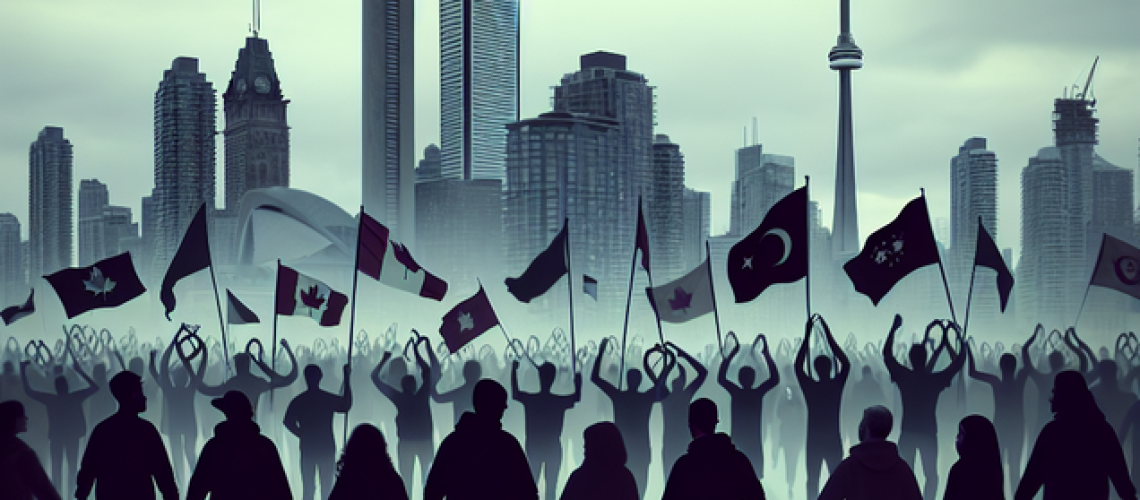

Under a grey Toronto sky, thousands surged down University Avenue, their chants ricocheting off high-rises and seeping into the city’s soundscape like a second heartbeat. Wrapped in velvet ropes of memory and defiance, a generation of Iranian-Canadians and allies gathered in one of the largest acts of diaspora defiance seen in Canadian history. This wasn’t just a protest—it was an eruption of transnational solidarity, where grief met political conviction and found its voice in Farsi, English, and a shared desire for dignity. From grandmothers holding up photos of executed sons to queer youth waving signs that read “Zan, Zendegi, Azadi,” the crowd embodied resistance across axes of gender, exile, and belonging.
“Every chant we raise here echoes in Evin Prison,” said Neda Farhadi, a second-generation activist whose father fled Iran after the 1988 massacres. She spoke beside her mother, who clutched the corner of their family’s old passport like a relic. It’s a ritualistic scene, one familiar in migrant solidarity circles—trauma passed down, reframed, and reactivated. According to Nour El-Bahr from the North American Coalition for Justice in Iran, these mass mobilizations are “not just cathartic but strategic; they apply pressure on foreign governments and awaken civil societies.” And indeed, what Toronto witnessed wasn’t an isolated cry, but part of a global chorus of diaspora-led actions in Berlin, Paris, and São Paulo.
This latest flare-up follows the regime’s crackdown on protests inside Iran, particularly those ignited by the murder of Jina Mahsa Amini in 2022. But what’s remarkable is how long the diaspora’s fire has kept burning. In Toronto, university students born long after the revolution marched alongside exiled journalists and former political prisoners, each carrying fragments of the same story. Their goals may differ—some demanding regime change, others calling for international sanctions—but their unity lies in moral clarity: authoritarianism thrives in silence, and silence is no longer an option.
Crucially, observers must resist the urge to interpret these movements as foreign crises exported into “peaceful” Western contexts. “This isn’t imported chaos,” explains Pouya Rahman from the Progressive Iranians of Canada, “it’s continuity.” The Toronto protest, far from a rupture, mirrors global patterns of diaspora-led accountability. Whether it’s Sudanese resistance collectives in Brooklyn or Palestinian solidarity groups in Marseille, the message is the same: our fates are intertwined. Borders may restrain movement, but not outrage, not grief, not hope. These networks communicate more rapidly than ministries and more honestly than headlines.
As flags fluttered and songs melted into slogans, one could sense the protest’s dual nature—mourning and mobilization, exile and belonging. This wasn’t just about Iran; it was about a world cracking from uneven freedoms and unmet justice. If regimes know no boundaries in oppression, then perhaps resistance must also know none. What Toronto bore witness to was an uprising without a return ticket—rooted in memory, unafraid of the future, and loud enough to be heard from Tehran to Parliament Hill.