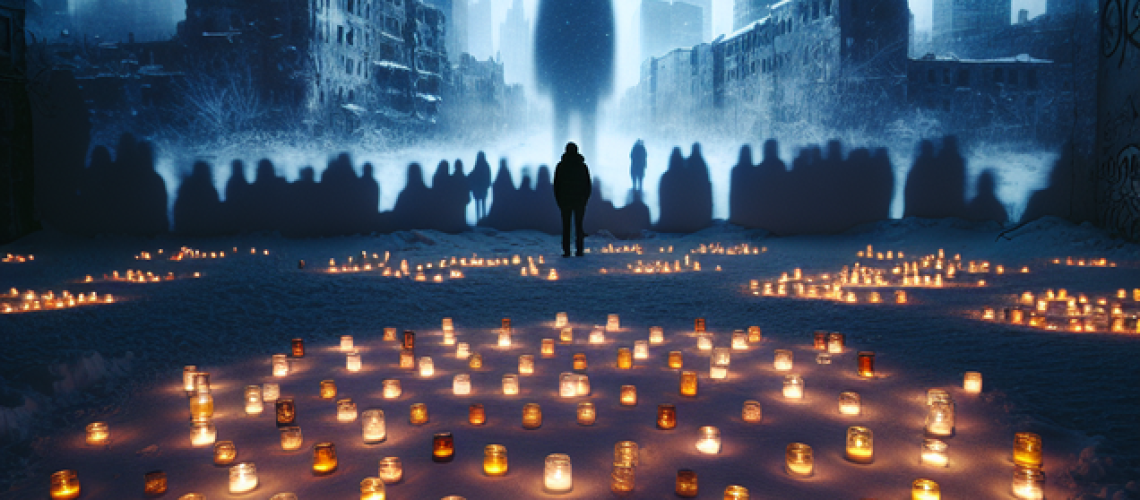
It was a bitter February night in Toronto when mourners gathered outside the community centre in Rexdale, candles lit for children in Gaza — and, by silent implication, for a teenager gunned down near Woodbine Mall just days earlier. The vigil, meant to spotlight the continuing siege of Gaza, unfolded in the shadow of another local tragedy, one that underscored the quiet violences always simmering closer to home. Wrapped in scarves and sorrow, people held panels reading “From Toronto to Palestine: Stop the Killing” and “Ceasefire Now,” as if to remind onlookers that not all bombs fall from drones — some come from neglected neighborhoods and systemic abandon.
Only 20 kilometers apart, Gaza and Woodbine might seem worlds away — but for attendees, their griefs were mutually legible. “Violence doesn’t start with the trigger,” said Samira Ben-Youssef, a nurse and longtime organizer who led chants in English and Arabic. “It starts with dispossession, with treating entire communities like they’re disposable.” Her words found resonance among Torontonians bearing fresh wounds: the teenager killed on Albion Road was the city’s fourth gun homicide this year, and the sense of cyclical loss was palpable. Beneath the city lights, protestors lit incense for both unnamed martyrs in Gaza and forgotten youth in Etobicoke.
Canada has long fashioned itself as a peace-loving middle power, but the veillée stitched together contradictions that diplomacy can’t iron out. While Ottawa maintains its quiet support for Israel, communities across the country are organizing nightly in opposition — linking arms across issues of land, oppression, and marginalization. Attendees spoke of how local housing evictions, racial profiling, and food insecurity form their own kind of siege, one that doesn’t make headlines unless blood is spilled. A Syrian refugee in attendance, Rami, noted bitterly: “It’s the same playbook, just different geographies.” The crowd murmured in agreement — after all, suffering seems to travel more freely than those fleeing it.
In covering global crises, we often risk abstraction — maps and body counts, but no emotional topography. This vigil resisted that flattening. Wrapped in keffiyehs and Canada Goose, people hugged, wept, and shared dates and mint tea from thermoses. One elder handed out printouts of Langston Hughes poems. “Solidarity isn’t sentimental,” said a 22-year-old Indigenous woman named Maya who held a placard that read “Free Palestine, Fund the People.” “It’s material. It’s about connecting our fights.” From Gaza’s shattered hospitals to Toronto’s over-policed corridors, the connections participants drew weren’t rhetorical; they were daily realities written on brown bodies the state regularly overlooks.
As the vigil wound down, someone projected footage of Gaza’s destroyed neighborhoods onto a building wall while a local spoken word artist quoted June Jordan: “I was born a Black woman and now / I am become a Palestinian.” In that moment, Toronto didn’t feel like a detached observer of tragedy, but a node in the same bruised, breathing body. The global south was not elsewhere — it pulsed right beneath our snow boots. In a world where injustice is so thoroughly networked, perhaps the only ethical response is a networked grief — stubborn, intersectional, and unwilling to stay silent.