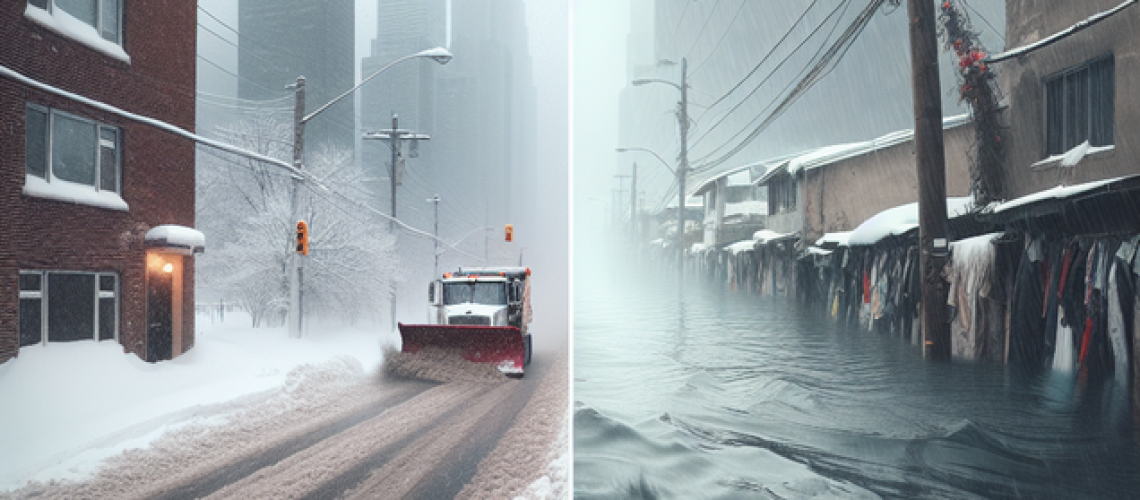
As Torontonians navigate waist-high snowbanks and overburdened municipal crews scramble to clear the aftermath of yet another winter storm, the scene feels oddly familiar — not for its meteorological drama but for its political inertia. In the same week, Kinshasa streets were swallowed by torrential floods, displacing thousands. Yet while Canadian snowplows guzzling diesel made headlines and got radio updates, the Congolese flood victims barely register beyond social media threads. This isn’t a geography problem; it’s a justice one. Climate disasters hit everywhere, but only some receive swift recovery plans or solemn speeches by former central bankers in Davos.
Mark Carney, now climate czar of capitalism, told the Davos elite we need to act faster on climate — a line he’s been polishing since 2019. Meanwhile, Indigenous women in Guatemala or seasonal workers from Bangladesh living in freezing Ontario trailers don’t need high-level panels to tell them what climate urgency feels like. From Toronto’s icy sidewalks to Jakarta’s rising seas, many communities are screaming not only for action but recognition. And the ones freezing or drowning first rarely get invited to the mic.
Let’s talk about adaptation — the new buzzword of Global North policy circles. It’s easier to talk ‘resilience’ than to redistribute. While Canadian neighborhoods get salt trucks and emergency alerts, coastal communities in Senegal build their own sandbag walls by hand. Migration is rising not because people want to move but because they can no longer stay. Climate is now both disaster and passport control. And the irony? Many migrants end up shoveling snow in countries whose emissions helped drown their rice fields in the first place.
In response, a transnational climate movement is pushing back — not just against carbon emissions but against narrative monopolies. From MAPA (Most Affected People and Areas) campaigners to grassroots collectives in Marseilles, Nairobi, or Montreal, activists are uniting around a shared slogan: “The climate has no borders; neither should solidarity.” It’s not enough to change bulbs or vote green in rich countries. Real action means listening to the South, funding reparative justice, and acting like we’re all on the same melting iceberg — because we are.
So what determines whose crises get sirens and whose get silence? Philosopher Judith Butler once asked, “Who is grievable?” — a brutal but clarifying lens. When snow in Toronto is seen as disruption and floods in Lagos as misfortune, we don’t just reinforce inequality — we institutionalize it. We might not all live in the same conditions, but we share the same atmosphere. Our weather may differ, but our futures — they are more entangled than ever.