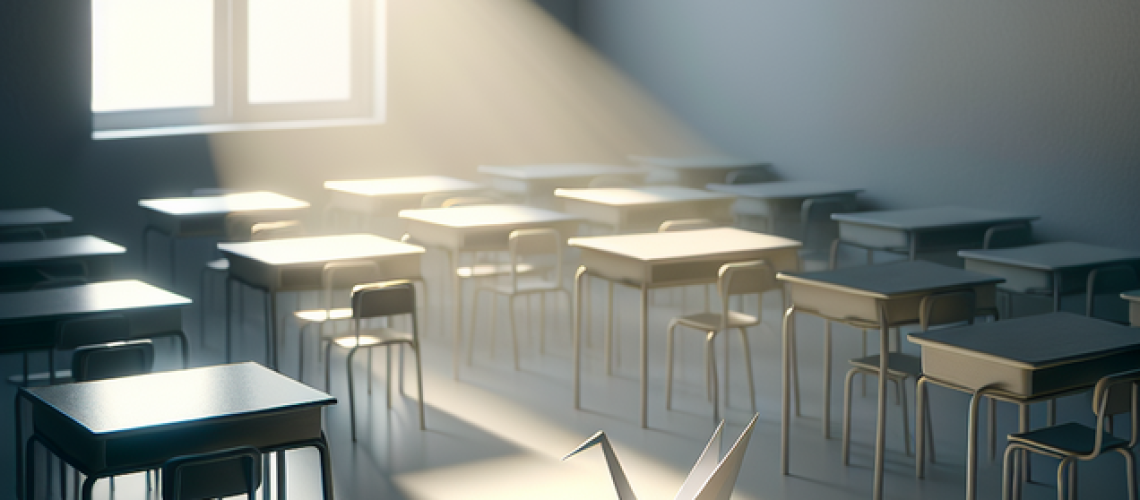

When Ms. Amina Boudreaux walks into her third-grade classroom each morning in Montreal-Nord, she carries more than lesson plans. She carries the weight of being a quasi-counselor, confidante, and sometimes even a lifeline for children struggling with trauma they don’t yet have words for. “I’ve had kids freeze under their desks because they heard loud noises,” she says quietly. “We were never trained for this. We just… care.” In the wake of the recent Tumbler Ridge tragedy, a haunting reminder of how violence finds its way into schools, educators across Canada are left asking: how much more are we expected to hold?
Public schools have become an unofficial frontline of community care— tasked not only with education but also with mental health triage, conflict mediation, and food provision. As rising economic pressures strain families, many children arrive at school carrying invisible burdens. In response, overtaxed educators scramble to fill the gap. “I’m not a psychologist,” remarks Etienne, a high school history teacher in Laval. “But some days, I spend more time de-escalating panic attacks than teaching.” The systemic shortage of school social workers, psychologists and trauma-informed support staff leaves glaring holes in safety nets that students urgently need.
And it’s the students—quiet, loud, anxious, angry—who are most affected. Marilou, 14, recounts days spent zoning out at her desk. “Sometimes, I just feel like I can’t breathe. But there’s no one to talk to, not for real,” she says. Her school has one part-time mental health worker for nearly 800 students. When crisis hits—like the scare that locked down her school last November—the trauma lingers. Without sustained support, students carry it with them. Schools, it seems, are being asked to absorb our collective emergencies without the tools to process them.
But there is hope in the margins. In neighborhoods like Parc-Extension, community-based mental health centres and food co-ops are partnering with schools on trauma-informed education initiatives. These models view behavior not as disruption but as communication—a call for care. “We started holding after-school circles that focus on emotions, not discipline,” says Tasha Nguyen from a local youth shelter. “The shift is subtle but powerful. Kids heal in community, not in isolation.” Yet these efforts remain patchy, grassroots, and underfunded. What happens in schools is not separate from what happens in the community—it is a mirror.
Every budget cut, every unfilled position, every underpaid educator or delayed intervention is a decision with a child’s name on it. We must stop asking schools to stitch together the torn fabric of our society with the threadbare resources they have. We need a national reckoning that sees schools not just as education sites, but as emotional and social sanctuaries. Healing is not just possible—it’s necessary. And it starts by listening to the voices inside our classrooms, before the silence becomes unbearable.